What is our Science Online Exam? (Seniors)
The NextGen Olympiad Science Online Exam is designed to challenge older students through our prestigious international competition. Built on Australian curriculum standards, this exam offers senior students worldwide the opportunity to demonstrate their scientific knowledge and compete with peers globally.
Our Science Online Exam features 25 carefully crafted multiple-choice questions designed to test scientific understanding, analytical thinking, problem-solving abilities, and logical reasoning appropriate for senior students. Students have 60 minutes to complete the exam, with questions covering science concepts including biology, chemistry, physics, and earth sciences that encourage scientific inquiry and critical thinking.
Exam Format
- 25 multiple-choice questions
- 50 minute duration
- Cambridge curriculum-aligned Content
- Multi-language support available
- Secure online proctoring
Scoring System
- 4 points for each correct answer
- 3 wrong answers void 1 correct answer
- Maximum score: 100 points
Global Round Qualification
The top 60% of performers will qualify for our prestigious Global Round in Sydney, Australia (April 2027), featuring enhanced prizes, international recognition, and an unforgettable educational experience.
Important Information
- Exam Date: 24 October 2026
- Registration Fee: IDR525K per student
- Download Complete Exam Rules & Guidelines
- Access All Sample Question Papers
- Download Online Round Poster
The Levels It's Broken Into
There are three categories of participation for our Senior Science Online Exam:
- Category 4– Ages 12-13 (Year 7-8)
- Category 5– Ages 14-15 (Year 9-10)
- Category 6– Ages 16-17 (Year 11-12)
Each category is specifically designed with age-appropriate science concepts including biology, chemistry, physics, and earth sciences while maintaining the challenge and engagement that makes our competition both educational and exciting.
Exam Topics
Senior Level 1 - Exam Topics⌄
Year 7-8 (Senior Level 1)
- Cells & Microscopy – cell structure and function (plant & animal cells), use of microscopes, unicellular vs. multicellular organisms
- Body Systems & Interactions – circulatory, respiratory, digestive, excretory, nervous systems; how they work together
- Reproduction in Plants & Animals – sexual and asexual reproduction, pollination, fertilisation, development
- Ecosystems & Interdependence – food webs, energy flow, matter cycling, human impacts, and biodiversity conservation
- Classification & Evolution – grouping organisms based on features, introduction to evolution and natural selection
- States of Matter & Particle Model – solids, liquids, gases, particle movement, changes of state
- Mixtures, Elements & Compounds – separation techniques, properties of substances, metals/non-metals/metalloids
- Atomic Structure & Periodic Table – protons, neutrons, electrons, atomic number/mass, arrangement in the periodic table, simple chemical symbols and formulas
- Chemical Reactions – signs of chemical change, word equations, combustion, acid–base, corrosion, and rates of reaction (intro)
- Forces & Motion – balanced/unbalanced forces, Newton's laws (intro), speed, acceleration, and motion graphs
- Energy Forms & Transformations – kinetic, potential, heat, light, sound, electrical; energy transfer and conservation
- Simple Machines & Mechanical Advantage – levers, pulleys, gears, inclined planes
- Earth Structure & Geological Time – layers of the Earth, plate tectonics, rock cycle, weathering, erosion
- Natural Hazards & Earth Processes – earthquakes, volcanoes, tsunamis, climate patterns
- Water Cycle & Weather Systems – evaporation, condensation, rainfall, air pressure, ocean currents, climate change (intro)
- Space Science – solar system, orbits, seasons, eclipses, lunar phases, relative sizes/distances, gravity in space, stars and galaxies (intro)
- Scientific Measurement & Data Analysis – metric units, accuracy, precision, repeatability, graphing, identifying trends and anomalies
Senior Level 2 - Exam Topics⌄
Year 9-10 (Senior Level 2)
Biological Sciences
- Cell Structure and Function – specialised cell organelles, cell theory, and microscopy
- Body Systems and Interdependence – coordination of systems (nervous, endocrine, circulatory, respiratory, reproductive)
- Ecosystem Interactions – energy flow, trophic levels, food webs, biodiversity, human impact
- Heredity and Genetics – DNA structure, genes, chromosomes, patterns of inheritance
- Evolution and Natural Selection – evidence, adaptation, and speciation processes
- Disease and Immunity – infectious vs. non-infectious diseases, immune responses
Chemical Sciences
- Atomic Structure & Periodic Table – subatomic particles, isotopes, electron shells, periodic trends, groups & periods
- Chemical Bonding & Reactions – ionic, covalent, metallic bonding; balancing equations; reaction types (acid–base, combustion, precipitation, redox)
- Conservation of Mass & Stoichiometry – mass relationships in chemical equations, mole concept (intro)
- Acids, Bases & pH – properties, indicators, neutralisation, common uses
- Rates of Reaction & Energy Changes – temperature, concentration, catalysts; endothermic & exothermic reactions
Earth & Space Sciences
- Solar System and Beyond – planets, moons, asteroids, comets, relative distances
- Earth's Systems – lithosphere, hydrosphere, atmosphere, biosphere interactions
- Plate Tectonics and Geological Processes – continental drift, earthquakes, volcanoes
- Rock Cycle and Minerals – igneous, sedimentary, metamorphic processes
- Climate Change and Human Impact – greenhouse effect, carbon cycle, sustainability
- Astronomy – life cycle of stars, galaxies, universe expansion, Big Bang theory
Physical Sciences
- Forces & Motion – Newton's laws, momentum, acceleration, mass vs. weight, motion graphs
- Energy Transfer & Transformations – mechanical, thermal, electrical, electromagnetic; conservation of energy
- Waves & Electromagnetic Spectrum – wave properties, sound, light, reflection/refraction, radio to gamma rays
- Electricity & Magnetism – current, voltage, resistance, Ohm's law, circuits, electromagnets, motors, generators
- Nuclear Science – radioactivity, half-life, nuclear energy, safety
Senior Level 3 - Exam Topics⌄
Year 11-12 (Senior Level 3)
Biology (Biological Sciences)
- Cell Biology & Biochemistry – cell structure, microscopy, biochemical processes, photosynthesis, respiration
- Genetics & Molecular Biology – DNA structure, replication, protein synthesis, genetic technologies
- Inheritance Patterns & Population Genetics – Mendelian and non-Mendelian inheritance, population variation
- Evolution & Biodiversity – mechanisms of evolution, speciation, adaptive radiation, conservation biology
- Ecology & Ecosystem Dynamics – ecosystem function, trophic levels, biogeochemical cycles, human impacts
- Human Physiology & Regulation – homeostasis, organ systems (nervous, endocrine, circulatory, immune), disease response
- Biotechnological Applications & Ethics – genetic engineering, cloning, CRISPR, ethical considerations
Chemistry (Chemical Sciences)
- Atomic & Electronic Structure – atomic models, electron configuration, periodic properties
- Bonding & Structure – ionic, covalent, metallic bonds, molecular shapes, intermolecular forces
- Stoichiometry & Chemical Calculations – moles, mass relationships, limiting reagents, solution concentration
- Rates, Equilibrium & Thermodynamics – reaction rates, collision theory, Le Châtelier's Principle, energy changes
- Acids, Bases & pH – acid–base strength, pH calculations, buffer systems, titration curves
- Redox & Electrochemistry – redox reactions, electrochemical cells, electrolysis, standard potentials
- Organic Chemistry – functional groups (alkanes, alkenes, alcohols), polymer chemistry, organic reactions
- Analytical Techniques – chromatography, spectroscopy (UV-Vis, NMR), qualitative and quantitative analysis
Physics (Physical Sciences)
- Mechanics – kinematics, dynamics, Newton's laws, momentum, energy transformations
- Thermodynamics – heat transfer, specific and latent heat, laws of thermodynamics, engines
- Waves & Optics – wave properties, interference, diffraction, reflection, refraction, lenses, optical devices
- Electricity & Magnetism – electric fields, circuits, Ohm's Law, magnetism, electromagnetic induction, transformers
- Modern Physics – quantum principles, photoelectric effect, wave–particle duality, atomic models, radioactivity, nuclear reactions
Earth & Environmental Science
- Earth System Science & Plate Tectonics – Earth's layers, plate boundaries, continental drift, mountain formation
- Geological Time & Earth Materials – rock cycle, mineral resources, fossil record, absolute/relative dating
- Atmosphere & Climate – climate zones, greenhouse effect, climate change, weather systems, human impact
- Hydrosphere & Biogeochemical Cycles – water balance, global hydrologic cycle, carbon and nitrogen cycles
- Resource Management & Sustainability – renewable vs. non-renewable resources, environmental management, conservation
What is the timeline for the Online Olympiad?
Registration Starts
1 Aug 2026
Registration Closes
17 Oct 2026
Exam Time
24 Oct 2026
Results Revealed!
31 Oct 2026
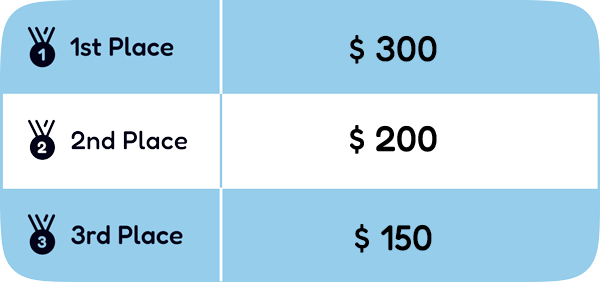
Prizes
Join thousands of students worldwide in this exciting scientific competition and discover your potential on the global stage!